Sunday, October 17, 2010

Teach on TV

The recent rise of interest in "saving our schools" has spawned two TV reality shows, Teach: Tony Danza, and School Pride. I remember the exasperation when Teach was first revealed. I don't need another person to tell me how to do my job. There's enough assholes in America today pontificating on the subject, despite lacking credentials or teaching certification. The idea behind the show is that Tony Danza will teach in an inner city school, learn how the system operates, and somehow teach his students and viewers about the reality in public education today. Surprisingly, it's doing a decent job.

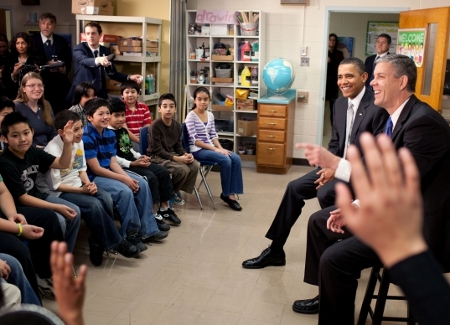
Like all first year teachers, Danza is terrible. Also like all first year teachers, he cares deeply about the students, and takes much of his failures to heart. Instead of being edited to show the dysfunction of the school system, the focus is on Danza. He stumbles his way through lessons, absorbs criticism from teachers and students, meets and angers parents, feels overwhelmed, and fears he is being ineffective. I enjoy this show because it reveals much of what first year teachers go through, and that teaching is a skill not learned by books and colleges, but through actually doing it. Danza himself quotes the study that shows 10,000 hours of doing anything can make you an expert. The principal tells Danza she wouldn't expect herself to dance or act after a short lesson on techniques, because they are difficult skills to learn. Danza should not expect the same of teaching for himself. Teach shows how Michelle Rhee, Davis Guggenheim, Barack Obama, or Arne Duncan would perform, how they criticize something they are unable to do. Teach shows how those leading "reform" would perform in reality. Education is not something a novice can stumble into and change. You need to know what you're doing first. You need your 10,000 hours.

My experience differs a bit from Danza's. What I found remarkable about Teach was that it appears as though Danza teaches only one class, and he has a teaching coach in the room every period. Most new teachers don't have it nearly as easy. The students seem well behaved, perhaps chosen as the TV class, assisting Danza with simple but important classroom management. He has already met dozens of parents. On back to school night I met the 3 parents of my 180 students. The "trouble students" seem like half my class. Nonetheless, I enjoy the show, and hope it continues to humanize the teaching profession, and show the reality of its difficulties.

School Pride is a new show, where outsiders come into an urban school with buckets of money, and fix up the school. The show gets corporate donors to sponsor classrooms. For example, the Microsoft Science Lab, Starter Sports Complex, and People Magazine Reading Room were shown prominently in the show, and called answers to our education problems. Corporate sponsorship is not the answer to school funding. Private advertising does not belong in public school. If your school doesn't have enough money, raise taxes or issue a bond or mill levy. We must invest in our future, not sell our kids short. No amount of paint will make up for slashed education budgets.

My fear is that people will watch these shows and believe themselves to be instant experts on the subject. The pattern of all the school "reform" talk these days continues to give voice to the novices, and none to the teachers. For any meaningful reform to happen, the pattern needs to be reversed.

Sunday, October 10, 2010

Burning the holy book.

The idea that you can use one source to gain all of your information is illogical. In what is supposed to be a rigorous learning environment, textbooks rarely are reliable enough to be used alone. In college, you have multiple texts for each class, on top of supplemental articles and readings from the professors. Why is it that in secondary education, textbooks are viewed as something holy, necessary, and indisputable. After my school administration insisted I dumb down my text, I made the conscious decision to have the students assassinate the textbook to their face.

This year my administration decided to get involved in the nuts and bolts of teaching, despite having less teaching experience than me. That says a lot. The situation reminds me of the time before I landed my first full-time teaching job, where I served as a para educator under some terribly uninspiring teachers. My administrator noticed I was using the AP book American Pageant for my honors US History students, as opposed to The Americans. He argued that American Pageant was district approved for AP classes only, not honors MYP. I had used the textbook last year because IB teachers requested the students have more rigor in their text, so that they are ready for the IB program. I wasn't about to die for a textbook, after all, they are only one source, so I complied and asked my students to change their books. The only time the textbook is used, is for homework. It would be insulting to have the students read the textbook in class. So now the students read a textbook below their reading level, as opposed to above it. The one factor that was incontestable, and struck me as something administrators could not ignore, was the absurdity of my honors and sheltered students both using the same text. Not their problem apparently.

I have been focusing on the bias of sources, and and the value of understanding bias. So far we have assessed the bias of the History Channel and district tests. For my formal observation I created a lesson to compare the bias of the textbook with the reality shown in primary sources. I wanted to show administration that even the students could see the stupidity of the decision to switch texts. The topic I picked revolved around the Civil War, being our current unit of study. I could have chosen Columbus, unionization, progressive movements, WWI, immigration, or any time period or topic. The students examined the textbook, and another source I got from the Zinn Education Project. At the end I asked the students, what is the bias of the textbook, what is the bias of the other source? Which source do you find most valid, and give examples to support your reasoning? What is the value of knowing the bias of the textbook?

The students lit it up. "The textbook disencourages people taking action to make change. The textbook maintains the status-quo. The textbook is biased by minimizing the actions of common people. The textbook tells us to wait for those in power to help, instead of helping ourselves." They nailed the bias. Administration watched, dumbstruck. "We need to know the bias of the textbook because we shouldn't believe everything we read. We need to know the bias so we know what our school is trying to teach us. The value of knowing the bias is to help us understand power." Those are all real quotes. I was surprised. Perhaps I created a class of revolutionaries. They saw The Americans was hardly worth the paper it was printed on, and assassinated it. A valuable lesson in the teaching of history and its effects on how we see ourselves.

Afterward, my administration was in awe. They loved the lesson for obvious reasons. My reason for having them view the lesson was completely lost on them, it went right over their head. Dim people. I figured it wouldn't be smart to point that out the them, considering I'm still not tenured. That lesson helped win over the students completely. They are now fascinated with historiography, bias, and historical perspective. Students respect the textbook as much as I do, something we have in common against the continuous dumbing down of our curriculum, mandated from above.

Sunday, October 3, 2010

Race to the Bottom

To add insult to injury, my state's bid for Race to the Top funding was denied, even after our state forced serious concessions from its teachers. Teachers in my state are no longer guaranteed tenure or non-probationary status. This was done in order to increase the probability of winning Race to the Top funds.

We continue to need three years of positive reviews in order to gain non-probationary status, but administration can now strip a teacher of that status after two years of unsatisfactory reviews. Essentially, administrators can no easily remove anybody they want.


Arne Duncan decided that stripping teachers of tenure protection wasn't enough. The unions had to kowtow, and capitulate in order to receive the money. Our unions refused to participate. As usual, those that don't teach think they know it all, and feel they can tell teachers how to do their job. So now we are vulnerable to the changing tides of administration, with no benefit whatsoever.

Friday, September 24, 2010

Two extremes that make (or don't) the day, cont...

After a student asked for white-out I responded "No amount of white-out can cover up the stain of ignorance." I was messing with her, she understood and enjoyed the gentle mocking.

On the other hand, another student said "My dad hits me when I don't cook." Shit.

Saturday, September 18, 2010

Oh, the things kids know


Yesterday I was teaching about about advantages the Union had in the Civil War. I was discussing the telegraph, and how it worked. One student raised their hand and asked, "So, phone sex must have been pretty boring back in the day?" Wow.

Sunday, September 12, 2010

"Mister, that's racist!"

The school I teach in is incredibly diverse. Not diverse as in mostly Latino or Black, I have students from every continent in my classroom. Our school is attempting to become what is called a 90/90/90 school, meaning 90% "minority", 90% free reduced lunch, and 90% proficient on ACT and state tests. Right now we are 90/90/30. Long way to go.

Because of our immense diversity, it leads to an eclectic mixed group, who are very aware of racism and prejudice. Some of them have a heightened victim complex, which I try to combat with lessons on people power which I described in my last post. Everybody can claim the victim somewhere in their history. Even the English, with all that Mayflower religious persecution business. Because I teach history, racism is an undeniable driver in many actions of our nations past. The students always yell "Hey mister, that's racist" over some historical event or article. No duh!

The problem is that the students transfer that idea to their teachers and administration. "You're just moving me because I'm ______." It takes awhile to break through such blind idiocy, but the end is inevitable. I usually respond by "Yes, I am racist. I hate all people who are not me equally." After that the kids chuckle, and mock the accusatory outburst of the student calling me racist. Sometimes the students call something racist as a joke. Sometimes I mock them by doing the same. They enjoy the back and forth. What they don't understand though, is the effect of seriously calling somebody racist. It forces that person to be defensive. Its ridiculous, and a constant battle. This is so common in our school, that I named my trivia team at the local pub, "Hey mister, that's racist." One of our other teachers was at that trivia game. When rankings were called out, they knew immediately which team was ours.

There are only two times in my teaching career that I have been dumbfounded to the point of silence over a student comment. One of those happened this week at parent-teacher conferences. I was conferring with a Latina student and her parents. She was translating for me. Suddenly she asked me "Mister, why do we have to study this stuff if it is over 150 years ago, it doesn't matter?" When students ask me that in class, I take the time to explain the importance of understanding your history in order to understand the power of the individual. The necessity of progress, and to compare where we came from to now. The students are always very satisfied with the empowering message. When this student asked me at conferences, I had 30 seconds. I had to think of something quick. I was not satisfied with what I came up with. I said "So you understand you don't have to be content being ruled by backwards rich dudes anymore, you can make history."

Her response shocked me. She said, "I hate white dudes." I was shocked, but not dumbfounded yet. I looked at her with exasperation and confusion. I said "Hey, I'm a white dude." She responded with "You're not white, mister."

I was aghast. If there was such thing as a racist compliment, that was it. This was the attitude I battled from students. They all saw me as a white dude, till I became "honorably" not White. It was like the day the students asked me who I voted for, and one student said "He voted for McCain because he's white." I didn't, and I became "honorably" non-White to them. In their minds, White means the enemy, the oppressor, a person to be reviled. Additionally shocking was how cavalierly it rolled off her tongue.

Am I a victim? Hell no. I understand what she meant. She knows that Whites have had a traditional advantage in this country. Students just need to understand that its not all Whites, not even most Whites actively participated in injustices in our history, although benefiting by association. There is a rich, long history of multi-racial movements fighting against those in power. Now I have to figure out a way to combat her misperception. The only way I can think of now is to increase the amount of time I spend on the multi-racial aspect of our equal rights struggles.

On the teaching of half truths

Recently I've become troubled by a dillema involving my US History courses. Currently I teacher honors and sheltered US history, among others. The gap between what I am able to teach to my honors students is massive, compared to the basics I seem to be forced to teach to my sheltered kids. That gap has forced me to teach half truths to my students, and I am struggling to find a way to introduce historical dilemmas, and empowering topics.

The way I have approached abolitionism and the Civil War is to emphasize the importance of slaves freeing themselves as opposed to being freed by Lincoln. After all, Lincoln was not the "Great Emancipator" that legend has made him out to be. He was brave, and eventually did the right thing, but it was only after a tremendous amount of pressure by abolitionists like Douglass, and the slaves themselves. The curriculum is designed to empower the students, and help them understand change comes from below, not above. How people change and improve their lives, and eventually force government to do what is right, is a continual theme in US history.

My honors students summed up Lincoln as essentially somebody who believes in the superiority of whites, but believes slavery is immoral. This is best summed up in Lincoln's own words.
I will say then that I am not, nor ever have been in favor of bringing about in anyway the social and political equality of the white and black races - that I am not nor ever have been in favor of making voters or jurors of negroes, nor of qualifying them to hold office, nor to intermarry with white people; and I will say in addition to this that there is a physical difference between the white and black races which I believe will forever forbid the two races living together on terms of social and political equality. And inasmuch as they cannot so live, while they do remain together there must be the position of superior and inferior, and I as much as any other man am in favor of having the superior position assigned to the white race. I say upon this occasion I do not perceive that because the white man is to have the superior position the negro should be denied everything.
Debate with Stephen Douglas 18 September 1858

In spite of Lincoln saying this in a debate, where most politicians will stretch truth to be elected, it is backed up by other similar comments from Lincoln's past. What Lincoln intended to do about slavery is best summed up by him here:
My paramount object in this struggle is to save the Union, and is not either to save or to destroy slavery. If I could save the Union without freeing any slave I would do it, and if I could save it by freeing all the slaves I would do it; and if I could save it by freeing some and leaving others alone I would also do that. What I do about slavery, and the colored race, I do because I believe it helps to save the Union; and what I forbear, I forbear because I do not believe it would help to save the Union.
Letter to Horace Greeley, The Liberator editor, 22 August 1862


Once my students realized Lincoln and the Civil War were not all about abolition of slavery, we examined how the slaves were freed. We studied slave sabotage and desertion to Union lines. We read letters from generals asking to use the freedmen as soldiers, and Lincoln denying their requests. It wasn't until those numbers became so enormous, and Lincoln saw political advantage to abolition, that he made official what had already happened.

I can't teach that to my sheltered students though. Some of them cannot even communicate with me beyond a good morning, or my name is Muganguzi, Modeste, Geeta, Govinda, Minh, or Javier. This difficulty caused me to teach that the Civil War was between North and South over slavery. The Emancipation Proclamation freed the slaves. Everything must be concrete, without ambiguity. The reason is two fold: time, and comprehension. Our district has us on strict pacing guides, with district wide exams that we are evaluated on as teachers. It is difficult enough to get the students to understand who John Brown was, and that the South had slavery, not the North. How can I teach about the intricacies of Lincoln's position, and that it wasn't him alone that freed the slaves?

I feel as though I am doing these students a disservice, but I don't know how to carry out such a curriculum with so many difficulties and handicaps in the way. My sheltered students can benefit greatly in learning on the power of the people to make and force change. They are used to everything being top down onto them. I want them to know that anything from school policy to immigration policy can be controlled by them, not the other way around. That is the message of history, not hero worship and benevolent government.