I have the best students in the world. They have taken their lessons in history, and applied them to their learning environment.
Over 600 of my students, 1/3 of the whole student body, signed a petition on my behalf. It tells admin that if they let me go, the students will have no faith in their administration and should expect the consequences. Today that was delivered to the only person in the building that has attacked me, and can reverse the decision. Rumor has it, it got under her skin.
Two weeks to go until the board decision on my future, and the students are still mobilizing.
Monday, March 21, 2011


Saturday, March 12, 2011
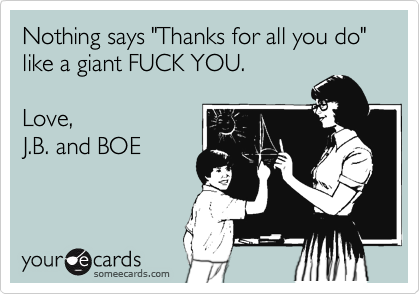
Life non-renewed
All teachers up for tenure were non-renewed, me being one of them. Although I have no rights because I am probationary, the union wants to help me fight it. All of the staff are shocked and angered. A great social injustice towards our students.
Administration got promoted. How ironic. Fighting this will accomplish one of two things. Embarrassing them in front of the school board, or a reversal of the non-renewal. I have one person's mind to change, everybody else is with me. Time to raise hell.
It will be a dramatic spring and summer.
Administration got promoted. How ironic. Fighting this will accomplish one of two things. Embarrassing them in front of the school board, or a reversal of the non-renewal. I have one person's mind to change, everybody else is with me. Time to raise hell.
It will be a dramatic spring and summer.
Tuesday, March 8, 2011
Experiments in patience and shit sifting
I remember a few years ago when I was new to this area, and fresh out of college, I was applying for jobs in all of the area districts. My job at the time was teaching social studies to all of the expelled students of a district. I was hired as a para, but worked as a teacher, just to keep myself busy, and my morale up. My co-workers treated me as a teacher, and not a para. There was mutual respect of what we did, and that got me through my first year. I needed to get into a classroom for myself though. When I talked of applying to my current district, everybody said not to do it. The schools were ghetto, the district leadership inept, students don't care, etc... I needed a job. I took it, and I love it. The students are a challenge, but open books. There is the possibility of making a huge difference with my students. That's why I continue to teach there.
Working in my school or district is a lesson in flexibility. How much longer can you put up with one administrator, one mandate, or it all until you snap. So many teachers are already burned out this year. They don't want to teach anymore, and don't even want to finish the school year. Our district has broken them. It is working on me. We live in a German scheisse (shiza) porn, always being shit on. There is no respect for teachers.
Our administrators are enforcing many of the schools "reforms" through a gotcha system. If you fail to meet the requirements of any of the new systems, you are a bad teacher, and need additional observations and a professional growth plan.
#1: You must have a proficiency wall. A proficiency wall has graded and annotated examples of student work. It must have a rubric, so if students need to see what proficient (B) work looks like, all they need to do is look at the wall. It's a good idea, but the kids don't care. It sits there, idle, taking up space.
#2: Standards based grading (SBG). You must evaluate your students using SBG and tie your lessons to state standards. I have three standards. My gradebook has to be divided into three sections. Some lessons are graded for "practice" while others are assessments. You can only give a grade on the assessments. You cannot penalize for late or missing work, because under SBG it is the progress of a student, not the final scores that counts. Last year I gave an honors student a D, and the helicopter mom went to administration to complain. My principal told me to let the student hand in work 3 weeks after the close of the quarter, because in SBG there is no late work, no study habits, no responsibility. Students now know they can't be penalized, guess how that is going?
#3: Common assessments. We must make common assessments with others who teach the same content. We are to come up with common goals for formative (quizzes) and summative (tests) assessments, and give those tests. You create these in your...
#4: Professional Learning Team (PLT): This is a collection of teachers in the same content. We must meet weekly and create assessments. Testing is very important. We align our assessments to state standards and...
#5: District pacing guides (PGs): These tell us what we should be teaching and when. If you are off the pacing guide, as I am, you get in trouble. I had to defend spending extra time teaching immigration to my IMMIGRANT students, because you can use their experiences as teachable moments. If you are off the pacing guide, you cannot create common assessments with you PLT, and you will be penalized on the...
#6 Interim Assessments (IAs): These are district tests that teach specific content and skills. Little did teachers know years ago, when we created these, that they would be used against us. Every teacher in the district uses these, and they are used to measure teachers against each other. There is a data room where each teacher's scores are posted and compared to each other. If your scores are low, you get on administration's radar, and they do drive-bys of your room often. When they come by your room, they look for...
#7 Unit objective (UO), essential question (EQ), and success criteria (SC): In English, that means unit question, daily question, and how students show they know the EQ. These must be posted and updated daily. They must correspond to the standards, vocabulary and content goals, and produce evidence of student learning. If they are "wrong" you get in trouble. If you forgot to update them, you get in trouble. It all works under a gotcha system. These are for students to see, so that everyday the students know what they are supposed to do. It's overly complicated, with little benefit.
#8 Professional Leaning Communities (PLCs): These used to be called departments. Now they are PLCs. This is where you collaborate with other teachers in the same department, and align your classes horizontally and vertically. That ensures there is no redundancy in what is taught.
#9 Data: The point of all of those ideas is to produce data. Numbers on charts and graphs that shows students are learning and improving. If you don't make sure your data looks good, you're screwed. Your data on IAs, common assessments, state tests, ACT, and other assessments are posted and compared with others in the data room. It does not assist or encourage improvement, only punishment of what is deemed poor performance.
I also have Instructional Leadership Team (ILT) and Middle Years Program (MYP) meetings and rubrics to attend because I am a department chair. It is maddening. When do I get to teach? Luckily for me, I am on top of the charts in the data game, so I am off the radar.
To make everything worse, our district broke our contract and gave us a sixth clas s to teach. Contract says five. We fought the implementation of this last year. I wrote about it then. I survived the budget cuts, but many other teachers were laid off. Our union, which I became a building representative for, filed a grievance with an arbitrator, and won. The arbitrator told the district they had illegally broken the contract and had to compensate us for our work. Unfortunately, the arbitrator's ruling was non-binding. Last week our union packed the Board of Education meeting where they were to decide on the ruling.
District shat on us. The superintendent told principals in elementary that accepting the arbitration would result in lost elementary jobs. Elementary principals brought out their staff. Our union was divided between high school and elementary. Their argument was that contact time with students was inequitable, between high school and elementary, that we only work 20 hours a week with students. This is completely false, and insulting, being that I work 50-60 hours a week. Also, it takes much longer to plan and grade for 170 students and essays, than it takes to grade 2 + 2 = 4. The BOE rejected the arbitration, and now we are going to file a lawsuit. The worst part of the week was the superintendent bringing up principals, chamber of commerce, elementary teachers, and parents telling us we were lazy, greedy, part-time, and ineffective. It was almost too much. We were there till 9:30, and parent teacher conferences were the next day after school.
People are burnt out. Between all the extra expectations that really do very little to improve instruction, the gotcha system, and no respect from our district, there are going to be a lot of vacancies. All of those extra expectations take up a lot of time, and we cannot plan or grade sufficiently well, on top of having 33% less plan, and 20% more work. I have three preps but only two plans. Some of the best teachers are being pushed out, and replaced by Teach for America grads. For example, one of our veteran teachers used payday lending abuses to teach his students advanced algebra. This is relevant to the student's lives. Students who were on the verge of being kicked out of school became math geeks. He was written up for this because that was not on the district pacing guide. It is insane. My battle is separating all of that crap, from what I love to do, teach. It's getting harder.
There is only so far you can push people who do what they do out of the kindness and care of their heart. The staff at my school is committed, professional, and caring. We went from 15% ESL to over 50% in 10 years, and did not decline in quality. We take knocks from district because we care about the students. However, there is a point at which it becomes abusive. That point is rapidly approaching.
I had one overwhelmingly positive experience this week. There is one administrator in our building who teachers have respect for. She is helpful, insightful, and is human. She is an expert on sheltered and ESL instruction, and shares her techniques in an efficient and non-threatening way. She always looks at the positives, and helps when you fall. She does not work under the gotcha system. I invited her into my room to see what I had done with my sheltered students. During parent teacher conferences, my two students from Myanmar brought in their parents. Zaw and Aye couldn't speak anything beyond "hello mister" to me two months ago. Now they are having basic conversation, and writing in my class. They are awesome. They were translating to their parents when my administrator walked in. I was nervous because she is somebody I respect, and I don't know if I am doing my job correctly with the sheltered students.
I had my proficiency wall and EQ, SC criteria up. She looked at my immigration projects. These are shadows of immigrant groups the students created, that had to represent various aspects of that group such as push and pull factors, assimilation, locations and religions, laws made against them, and contributions to the country. The students had to show that criteria through art. Students who cannot speak to me were able to complete this project. The silhouettes are walking towards the statue of liberty in a nice symbolic manner. The goal is to get the students to understand that their story is similar to older immigrant groups. Same story, different locations. My administrator walked around the room with her jaw open. She was amazed, and asked if she could return with a camera. I agreed. She told me that was one of the greatest, accessible, but still rigorous lessons for ESL students she has seen. I did well, and used none of the PLT, SC, or SBG methods. Just imagine what I could do if I wasn't one of those free loading part time lazy teachers.
Working in my school or district is a lesson in flexibility. How much longer can you put up with one administrator, one mandate, or it all until you snap. So many teachers are already burned out this year. They don't want to teach anymore, and don't even want to finish the school year. Our district has broken them. It is working on me. We live in a German scheisse (shiza) porn, always being shit on. There is no respect for teachers.
Our administrators are enforcing many of the schools "reforms" through a gotcha system. If you fail to meet the requirements of any of the new systems, you are a bad teacher, and need additional observations and a professional growth plan.
#1: You must have a proficiency wall. A proficiency wall has graded and annotated examples of student work. It must have a rubric, so if students need to see what proficient (B) work looks like, all they need to do is look at the wall. It's a good idea, but the kids don't care. It sits there, idle, taking up space.
#2: Standards based grading (SBG). You must evaluate your students using SBG and tie your lessons to state standards. I have three standards. My gradebook has to be divided into three sections. Some lessons are graded for "practice" while others are assessments. You can only give a grade on the assessments. You cannot penalize for late or missing work, because under SBG it is the progress of a student, not the final scores that counts. Last year I gave an honors student a D, and the helicopter mom went to administration to complain. My principal told me to let the student hand in work 3 weeks after the close of the quarter, because in SBG there is no late work, no study habits, no responsibility. Students now know they can't be penalized, guess how that is going?
#3: Common assessments. We must make common assessments with others who teach the same content. We are to come up with common goals for formative (quizzes) and summative (tests) assessments, and give those tests. You create these in your...
#4: Professional Learning Team (PLT): This is a collection of teachers in the same content. We must meet weekly and create assessments. Testing is very important. We align our assessments to state standards and...
#5: District pacing guides (PGs): These tell us what we should be teaching and when. If you are off the pacing guide, as I am, you get in trouble. I had to defend spending extra time teaching immigration to my IMMIGRANT students, because you can use their experiences as teachable moments. If you are off the pacing guide, you cannot create common assessments with you PLT, and you will be penalized on the...
#6 Interim Assessments (IAs): These are district tests that teach specific content and skills. Little did teachers know years ago, when we created these, that they would be used against us. Every teacher in the district uses these, and they are used to measure teachers against each other. There is a data room where each teacher's scores are posted and compared to each other. If your scores are low, you get on administration's radar, and they do drive-bys of your room often. When they come by your room, they look for...
#7 Unit objective (UO), essential question (EQ), and success criteria (SC): In English, that means unit question, daily question, and how students show they know the EQ. These must be posted and updated daily. They must correspond to the standards, vocabulary and content goals, and produce evidence of student learning. If they are "wrong" you get in trouble. If you forgot to update them, you get in trouble. It all works under a gotcha system. These are for students to see, so that everyday the students know what they are supposed to do. It's overly complicated, with little benefit.
#8 Professional Leaning Communities (PLCs): These used to be called departments. Now they are PLCs. This is where you collaborate with other teachers in the same department, and align your classes horizontally and vertically. That ensures there is no redundancy in what is taught.
#9 Data: The point of all of those ideas is to produce data. Numbers on charts and graphs that shows students are learning and improving. If you don't make sure your data looks good, you're screwed. Your data on IAs, common assessments, state tests, ACT, and other assessments are posted and compared with others in the data room. It does not assist or encourage improvement, only punishment of what is deemed poor performance.
I also have Instructional Leadership Team (ILT) and Middle Years Program (MYP) meetings and rubrics to attend because I am a department chair. It is maddening. When do I get to teach? Luckily for me, I am on top of the charts in the data game, so I am off the radar.
To make everything worse, our district broke our contract and gave us a sixth clas
 s to teach. Contract says five. We fought the implementation of this last year. I wrote about it then. I survived the budget cuts, but many other teachers were laid off. Our union, which I became a building representative for, filed a grievance with an arbitrator, and won. The arbitrator told the district they had illegally broken the contract and had to compensate us for our work. Unfortunately, the arbitrator's ruling was non-binding. Last week our union packed the Board of Education meeting where they were to decide on the ruling.
District shat on us. The superintendent told principals in elementary that accepting the arbitration would result in lost elementary jobs. Elementary principals brought out their staff. Our union was divided between high school and elementary. Their argument was that contact time with students was inequitable, between high school and elementary, that we only work 20 hours a week with students. This is completely false, and insulting, being that I work 50-60 hours a week. Also, it takes much longer to plan and grade for 170 students and essays, than it takes to grade 2 + 2 = 4. The BOE rejected the arbitration, and now we are going to file a lawsuit. The worst part of the week was the superintendent bringing up principals, chamber of commerce, elementary teachers, and parents telling us we were lazy, greedy, part-time, and ineffective. It was almost too much. We were there till 9:30, and parent teacher conferences were the next day after school.
People are burnt out. Between all the extra expectations that really do very little to improve instruction, the gotcha system, and no respect from our district, there are going to be a lot of vacancies. All of those extra expectations take up a lot of time, and we cannot plan or grade sufficiently well, on top of having 33% less plan, and 20% more work. I have three preps but only two plans. Some of the best teachers are being pushed out, and replaced by Teach for America grads. For example, one of our veteran teachers used payday lending abuses to teach his students advanced algebra. This is relevant to the student's lives. Students who were on the verge of being kicked out of school became math geeks. He was written up for this because that was not on the district pacing guide. It is insane. My battle is separating all of that crap, from what I love to do, teach. It's getting harder.
There is only so far you can push people who do what they do out of the kindness and care of their heart. The staff at my school is committed, professional, and caring. We went from 15% ESL to over 50% in 10 years, and did not decline in quality. We take knocks from district because we care about the students. However, there is a point at which it becomes abusive. That point is rapidly approaching.
I had one overwhelmingly positive experience this week. There is one administrator in our building who teachers have respect for. She is helpful, insightful, and is human. She is an expert on sheltered and ESL instruction, and shares her techniques in an efficient and non-threatening way. She always looks at the positives, and helps when you fall. She does not work under the gotcha system. I invited her into my room to see what I had done with my sheltered students.
 During parent teacher conferences, my two students from Myanmar brought in their parents. Zaw and Aye couldn't speak anything beyond "hello mister" to me two months ago. Now they are having basic conversation, and writing in my class. They are awesome. They were translating to their parents when my administrator walked in. I was nervous because she is somebody I respect, and I don't know if I am doing my job correctly with the sheltered students.
I had my proficiency wall and EQ, SC criteria up. She looked at my immigration projects. These are shadows of immigrant groups the students created, that had to represent various aspects of that group such as push and pull factors, assimilation, locations and religions, laws made against them, and contributions to the country. The students had to show that criteria through art. Students who cannot speak to me were able to complete this project. The silhouettes are walking towards the statue of liberty in a nice symbolic manner. The goal is to get the students to understand that their story is similar to older immigrant groups. Same story, different locations. My administrator walked around the room with her jaw open. She was amazed, and asked if she could return with a camera. I agreed. She told me that was one of the greatest, accessible, but still rigorous lessons for ESL students she has seen. I did well, and used none of the PLT, SC, or SBG methods. Just imagine what I could do if I wasn't one of those free loading part time lazy teachers.
Sunday, March 6, 2011
things dat r gay stuff etc.
did u no dat gramer is not taut anymore? english teechrs cant teech it, leaving it 2 us social studies teechrs. not cuz dey dont want 2, cuz admin wont let it happen. we h8 it.
In terms of student caused annoyance, grammar is definitely high on the list. The causes of poor grammar are hotly debated, if supported at all. As a Social Studies teacher, very often my subject matter becomes applied English. I assign a lot of writing, and continuously am awed by what the students turn in. Text language often substitutes for real words. There is no organization, no thesis or topic sentences. Surprisingly, many students can engage in proper verbal communication, but are unable to put the same down on paper.
Students also tend to have trouble support positions with evidence and fact. The ability to very quickly check Wikipedia at any time allows students instant knowledge without any critical thought. I continuously battle with students over their grades.
"Why did I get a C?"
"Because it's not enough to say the Maya were destroyed by drought. How do you know that"
"I dunno, I read it on this website"
"Where is the evidence?"
Student points at screen.
"There is no evidence there, that is a secondary source"
"Mister, that's gay. This is hard"
"There is nothing homosexual about that website"
"Sorry mister."
Of course, if blogs existing decades ago I'm sure teachers would be saying the same thing. My issue is that our educational culture is not improving. There are now so many outside stimuli facilitating learned helplessness. At least now facebook has a spell check option, although my students don't use it. What we must do is change our curriculum to meet the challenges created by technology, and use that same technology to facilitate improved cultural and academic literacy.
For example, using facebook for learning. I had the students debate the necessity of dropping he atomic bombs on Japan. The two examples should contrast, showcasing my arguments above. One is the product of my teaching, and although slightly scatter brained, shows high levels of critical thinking. The other suffers from learned helplessness.
In terms of student caused annoyance, grammar is definitely high on the list. The causes of poor grammar are hotly debated, if supported at all. As a Social Studies teacher, very often my subject matter becomes applied English. I assign a lot of writing, and continuously am awed by what the students turn in. Text language often substitutes for real words. There is no organization, no thesis or topic sentences. Surprisingly, many students can engage in proper verbal communication, but are unable to put the same down on paper.
Students also tend to have trouble support positions with evidence and fact. The ability to very quickly check Wikipedia at any time allows students instant knowledge without any critical thought. I continuously battle with students over their grades.
"Why did I get a C?"
"Because it's not enough to say the Maya were destroyed by drought. How do you know that"
"I dunno, I read it on this website"
"Where is the evidence?"
Student points at screen.
"There is no evidence there, that is a secondary source"
"Mister, that's gay. This is hard"
"There is nothing homosexual about that website"
"Sorry mister."
Of course, if blogs existing decades ago I'm sure teachers would be saying the same thing. My issue is that our educational culture is not improving. There are now so many outside stimuli facilitating learned helplessness. At least now facebook has a spell check option, although my students don't use it. What we must do is change our curriculum to meet the challenges created by technology, and use that same technology to facilitate improved cultural and academic literacy.
For example, using facebook for learning. I had the students debate the necessity of dropping he atomic bombs on Japan. The two examples should contrast, showcasing my arguments above. One is the product of my teaching, and although slightly scatter brained, shows high levels of critical thinking. The other suffers from learned helplessness.
And #2.I believe that bombing Hiroshima and Nagasaki was a tactic to scare the Russians from entering the war between Japan and the US and it was unnecessary. I recall from reading the recent article by Zinn A People's war?, that we (the United States) saw the Soviet Union as a threat. One, because even after the destruction, their military and economy was regaining strength at an exponential rate. Another reason is because they were a communistic nation, which opposed our capitalistic beliefs and our imperialism to create a global economy that is dependent on the US. Also background knowledge from the reading, post-war, we were in a competition with the Soviet Union for world power. As this website states http://www.ncesa.org/html/hiroshima2.html "The United States government knew 3 things the Japanese government did not...One which was that the Russians were coming into the war". I think the US was paranoid if the Russians did enter the war and seize Japan, they could have control over the Pacific with our military bases and Southeast's Asia's natural resources. Although Hiroshima contained 2nd Army Headquaters that control the military of southern Japan, the US only CONSIDERED it a military necessity. While on the other hand, Nagasaki was a huge seaport in Southern Japan that supplied ships, military equipment and other military supplies through out Japan. In addition, Nagasaki's buildings were constructed of paper and other materials that caught fire quickly. http://avalon.law.yale.edu/20th_century/mp06.asp But, in my opinion, the cities that were bombed didn't prove to be a huge military necessity; which supports the reason why it was unjust. which also means that the bombings were war crimes.
As clear as day. The first comment is researched, reasoned, and organized. The second is from the hip. Unfortunately, all to often I receive #2. However, using facebook has helped many of the students understand reasoned debate, using facts, not impressions. Using tools to facilitate learning instead of allowing those tools to destroy it must be a continued focus of schools. If that happens, teachers will get fewer politicians like Scott Walker thinking "yea atomic bomb on your ass."I think that the bombing of Hiroshima and Nagasaki wasnt nessessary to end the war. yes japanese bombers did kill some of our civilians during the attack of Pearl Harbor, so the US eventually decided to do the same to at least avenge some o...f those civilians that weren't supposed to die but as well as our soldiers as well. Even though the people and the soldiers were like yea atomic bomb on your ass. Even so the bomb that hit first was necessary because of the many american citizens that were held captives and were tortured to death, but on the other hand i don't think that the second bomb wasn't necessary to end the war. I also think that with out the bomb, but if we just still bombed Nagasaki maybe they japanese would've surrendered much easier instead of us just giving them their just desserts with the atomic bomb.
Saturday, February 26, 2011
My working conditions are your kid's learning conditions
Somebody has decided to make a new video that is in the know to my current situation. Turns out everybody is getting harassed right now. Administration has become Stalinesque in their paranoia and perception of unprofessionalism.
Our Friday after school teacher drinking session was the biggest its been in months.
Our Friday after school teacher drinking session was the biggest its been in months.
Saturday, February 19, 2011
Wisconsin as a watershed moment
My friends have been in Madison, WI because they are standing up for what they believe in. There is much debate going on in the media about what that exactly is. There seems to be two minds opposing the teachers and public employees. One is of the belief that the pain and belt tightening must be shared. The other believes that unions are illegitimate and should have no rights.
The former is illogical for a couple of reasons. Why do we give tax cuts to the rich, and demand working families and children tighten the belt? For many of the fiscal conservatives, the double talk hypocrisy has reached contemptible heights. As a society we must have priorities.
The latter is the age old argument by Republicans who wish for business model management to be imposed on public schools. Unions do not hire or fire employees. Unions do not defend bad teachers. Unions give people due process rights, as given by contracts with schools. A teacher is a slightly different kind of employee. Teachers are highly skilled and specially trained. Due process rights are there to provide security for a teacher to experiment, tinker, fail and succeed, and innovate without threat of unemployment. If the teacher is unable to perform up to expectations, administrators have full power to remove that person.
The issue there comes down to how much the administrator is willing to do. Very often the answer is very little, or the administrator is climbing the ladder, and will be gone in a year or two.
Five years ago I started my teaching career in a small unionized GM city in Wisconsin. I have a real soft spot for Wisconsin and it has been incredible to see the solidarity and positivity the public employees are demonstrating there. Today, I'm a member of the union, and a building representative. Every day, I see the necessity of the union.
This year administration has begun harassment of teachers, and turned the climate toxic. Our building had a climate survey, polling the opinions of the teachers. Over 70% of teachers reported feeling unappreciated, that administration has no concept of the difficulty of their job, don't feel supported, don't feel they have a voice in the direction of the school and district, and would leave if given the chance. Teachers are being pulled into the principal's office for minor 'offenses' such as sending out an email with an inspirational video.
Right now, our school is an anomaly in the district for our increasing test scores. The reason is because of the incredible staff I work with. We are professionals. The survey shows that one of three positive responses was that teachers work cooperatively and respect each other.
If administration had the ability, most of the veteran teachers responsible for our student's growth would be fired for minor silly 'offenses'. I recently caught the administration's ire for some supposed unprofessionalism at professional development. I left PD on ELA strategies to get my ELA class started on a lesson. I learned strategies that I used and got commendations for by all administrators. One person decided they didn't like my leaving. I got written up and put on a growth plan. My status for next year is now uncertain. Even though my teaching has always been praised, been given awards for having the highest scores, shared my curriculum with staff, and been recognized as a department and school leader, I might be fired. When I told my colleagues that story they all had the same reaction. They laughed, then realized I was serious.
This is why we need unions. Administrators come and go. Some like you, some don't. What remains are skilled specialized teachers, who sacrifice so much for their students. If the priorities of our country are tax cuts for those making half a million dollars, poverty for teachers, and crumbling schools, fine. Just say what your true intention is, then we can begin to have a conversation "without the base alloy of hypocrisy."
I wanted to add a video that gave me goosebumps. Under Gov. Walkers plan, firefighters would be exempt from the changes. In a show of solidarity, they marched in to support the public employees in full dress uniform, bagpipes blaring. I think the general public needs to channel this energy, and support the schools and teachers, instead of attacking them.
The former is illogical for a couple of reasons. Why do we give tax cuts to the rich, and demand working families and children tighten the belt? For many of the fiscal conservatives, the double talk hypocrisy has reached contemptible heights. As a society we must have priorities.
The latter is the age old argument by Republicans who wish for business model management to be imposed on public schools. Unions do not hire or fire employees. Unions do not defend bad teachers. Unions give people due process rights, as given by contracts with schools. A teacher is a slightly different kind of employee. Teachers are highly skilled and specially trained. Due process rights are there to provide security for a teacher to experiment, tinker, fail and succeed, and innovate without threat of unemployment. If the teacher is unable to perform up to expectations, administrators have full power to remove that person.
The issue there comes down to how much the administrator is willing to do. Very often the answer is very little, or the administrator is climbing the ladder,
 and will be gone in a year or two.
Five years ago I started my teaching career in a small unionized GM city in Wisconsin. I have a real soft spot for Wisconsin and it has been incredible to see the solidarity and positivity the public employees are demonstrating there. Today, I'm a member of the union, and a building representative. Every day, I see the necessity of the union.
This year administration has begun harassment of teachers, and turned the climate toxic. Our building had a climate survey, polling the opinions of the teachers. Over 70% of teachers reported feeling unappreciated, that administration has no concept of the difficulty of their job, don't feel supported, don't feel they have a voice in the direction of the school and district, and would leave if given the chance. Teachers are being pulled into the principal's office for minor 'offenses' such as sending out an email with an inspirational video.
Right now, our school is an anomaly in the district for our increasing test scores. The reason is because of the incredible staff I work with. We are professionals. The survey shows that one of three positive responses was that teachers work cooperatively and respect each other.
If administration had the ability, most of the veteran teachers responsible for our student's growth would be fired for minor silly 'offenses'. I recently caught the administration's ire for some supposed unprofessionalism at professional development. I left PD on ELA strategies to get my ELA class started on a lesson. I learned strategies that I used and got commendations for by all administrators. One person decided they didn't like my leaving. I got written up and put on a growth plan. My status for next year is now uncertain. Even though my teaching has always been praised, been given awards for having the highest scores, shared my curriculum with staff, and been recognized as a department and school leader, I might be fired. When I told my colleagues that story they all had the same reaction. They laughed, then realized I was serious.
This is why we need unions. Administrators come and go. Some like you, some don't. What remains are skilled specialized teachers, who sacrifice so much for their students. If the priorities of our country are tax cuts for those making half a million dollars, poverty for teachers, and crumbling schools, fine. Just say what your true intention is, then we can begin to have a conversation "without the base alloy of hypocrisy."
I wanted to add a video that gave me goosebumps. Under Gov. Walkers plan, firefighters would be exempt from the changes. In a show of solidarity, they marched in to support the public employees in full dress uniform, bagpipes blaring. I think the general public needs to channel this energy, and support the schools and teachers, instead of attacking them.
Sunday, February 6, 2011
Facts are funny things
The anti-teacher and anti-public school witch hunt these days is becoming more and more bellicose. Waiting for Superman by Davis Guggenheim just got the Oscar snub, and was rejected by Roger Ebert. One article that fought the propaganda in the film and pushed back was by Diane Ravitch in the New York Times movie reviews. Diane Ravitch was a supporter of No Child Left Behind, charter schools, and teacher "accountability." She has since come out against all of them, and become on the of the great defenders of the teaching profession.
In the review, Ravitch points out how Guggenheim, Rhee, Gates, and Obama currently point to certain examples of charter school or foreign success to justify their attacks on public education. For example, Finland is pointed to as an example the US should emulate. Unfortunately for the 'reformers', Finland has a 5% poverty rate and the teachers are 100% unionized. Charter schools fail twice as often as they surpass their public school equivalents. People say there are too many bad teachers. Most of those "bad teachers" are part of the 50% of people who leave teaching within the first five years. Those are just a few of the inconvenient facts that get in the way of those arguing for privatization of the education system.
As shown in the PISA reports that I wrote about in an early blog, it is not our teachers or schools that are necessarily the problem, it is poverty. If we continue to ignore the fact that poverty affects education, we will never improve education. Once we begin to tackle poverty, then the focus can shift to what schools can do differently.
As many have famously said, most recently the great Stephen Colbert; everybody is entitled to their own opinion, not their own facts.

In the review, Ravitch points out how Guggenheim, Rhee, Gates, and Obama currently point to certain examples of charter school or foreign success to justify their attacks on public education. For example, Finland is pointed to as an example the US should emulate. Unfortunately for the 'reformers', Finland has a 5% poverty rate and the teachers are 100% unionized. Charter schools fail twice as often as they surpass their public school equivalents. People say there are too many bad teachers. Most of those "bad teachers" are part of the 50% of people who leave teaching within the first five years. Those are just a few of the inconvenient facts that get in the way of those arguing for privatization of the education system.
As shown in the PISA reports that I wrote about in an early blog, it is not our teachers or schools that are necessarily the problem, it is poverty. If we continue to ignore the fact that poverty affects education, we will never improve education. Once we begin to tackle poverty, then the focus can shift to what schools can do differently.
As many have famously said, most recently the great Stephen Colbert; everybody is entitled to their own opinion, not their own facts.
Subscribe to:
Posts (Atom)